CONTENT
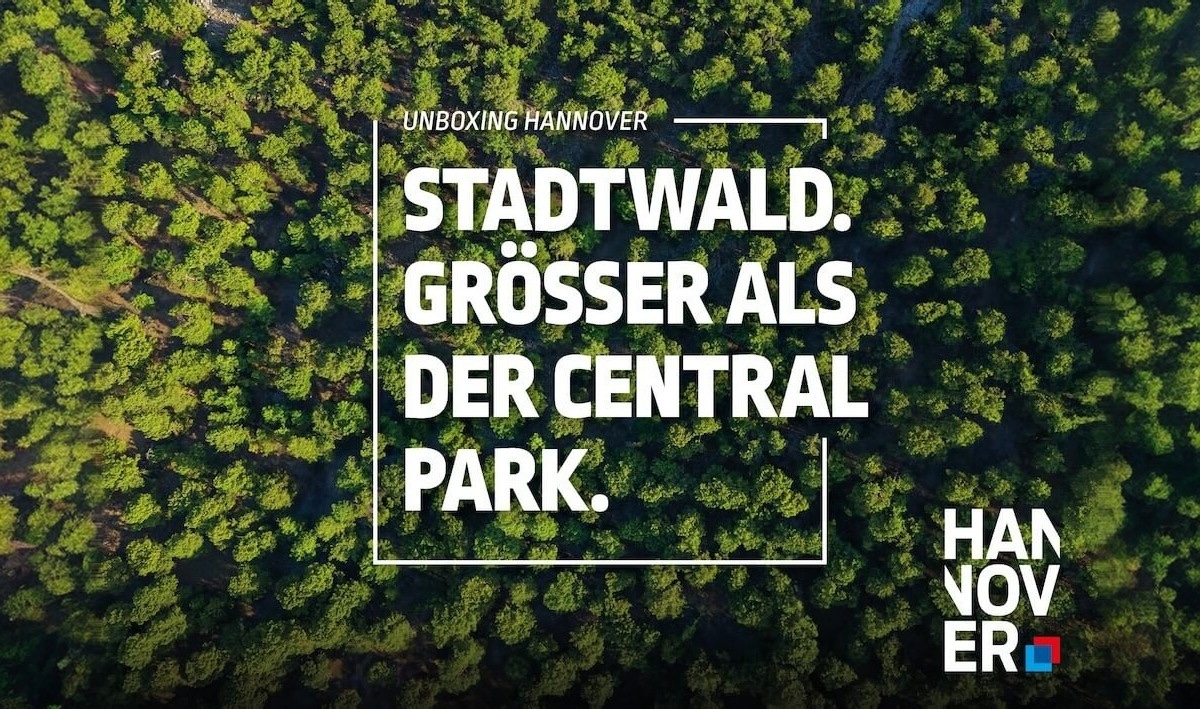
“As well as” instead of “either or”: combining hard facts and soft forces
Today, cities are competing simultaneously for skilled workers, students, companies, investments and visitors. And this competition between cities continues to intensify because the differences between cities are often blurred in terms of perception: Many cities in Germany lack a clear profile.
The problem behind this: Cities that are not clearly positioned are classified as “unclear” and therefore “average” in the minds of the target groups. One thing is clear: average rarely wins.
This is exactly where holistic positioning in place marketing comes in: A location always works as a combination of hard and soft location factors. However, it is crucial not only to be able to present both dimensions, but also to tell them as a consistent story. The new flagship campaign “Unboxing Hannover” by Hannover Marketing und Tourismus GmbH (HMTG), which was presented on February 18, 2026, shows how this logic works.
Abstract:
In the competition between cities, it is not just what a location can do, but how it feels that is decisive: cities that separate hard and soft identities from one another are failing to communicate with their target groups .
But how do cities combine hard and soft location factors to create a holistic and credible positioning? Strategy expert Thorsten Kausch shows this using the example of the “Unboxing Hannover” flagship campaign – a Stadtmanufaktur project in cooperation with Pahnke Hamburg and Brandmeyer Markenberatung.
Why hard location factors alone are not enough
Hard location factors can be a city’s “entry ticket” when it comes to companies or people choosing a location, but they are rarely the differentiating factor. Many cities can plausibly claim “good connections”, “attractive jobs” or “strong scientific institutions”. What is often missing is the translation: what concrete emotional evidence, experiences and images make these strengths credible and memorable?
Ask ten people what a city stands for and you will rarely get key figures, but rather stories (“There you can …”), mental images (“I see …”) or feelings (“The city has an effect on me …”). It is precisely this social and societal dimension of a location that determines whether hard facts are remembered at all.
“Hard location factors explain why a location works, soft location factors explain why people want to stay there. Without a holistic city narrative that takes people, everyday life and attitude into account, location marketing remains ineffective.”
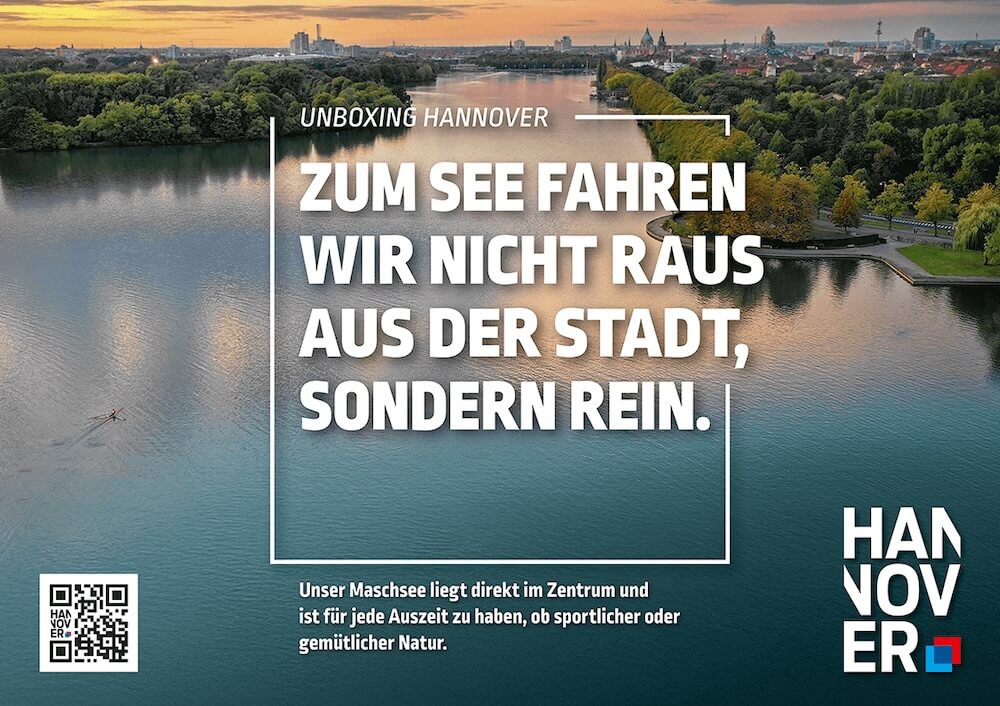
One of the motifs of Hannover’s new flagship campaign “Unboxing Hannover” focuses on nature within the city © HMTG
“Unboxing Hanover”: From analysis to narrative
The “Unboxing Hannover” project shows how a city can reflect on its current positioning and transform it in a focused way. The starting point in Hanover was an analysis in the Brandmeyer City Brand Monitor 2025. The results show: Hannover’s external image is perceived as “blurred and diffuse”. Only 37 percent of Germans associate concrete ideas with the capital of Lower Saxony. So what to do?
Definition: Hard location factors
Hard location factors (also quantitative location factors) are objectively measurable, quantifiable criteria of a location that can be compared between cities, which are evaluated in particular by companies, investors, skilled workers or students when choosing a location.
Examples of hard location factors include the labor market and industry mix: Labor market and industry mix, infrastructure and transport connections, education and research landscape, taxes and duties as well as the availability of commercial and residential real estate.
Hard location criteria are often shaped by structural and economic policy and can usually only be changed or improved in the medium to long term.
Systematic approach with participation and courage
What is exciting about the Hanover case is not only the resulting lead campaign “Unboxing Hannover”but also the systematic approach to the project: First, positioning strengths were compiled from strategy papers and studies and then fleshed out using stakeholder workshops . In this participatory approach, more than 100 stakeholders worked on priorities, strengths, stories, imagery and attributes in seven workshops.
This reveals a core principle of good location marketing: the profile of a city is created from evidence – paired with participation and the courage to condense. Only when it is clear which topics credibly resonate with the target groups is the creative translation worthwhile.
Among other things, the workshops prioritized topics that are attractive to skilled workers and guests. This included overlaps in location factors such as leisure and events, mobility and short distances, art and culture, location and surroundings. Next step: The findings were concretized and each topic area with actual conditions in the city.
Hannover’s strengths in the area of Leisure and events are reflected, for example, in city festivals such as the Maschsee Festival, the concert infrastructure, popular and outdoor sports, nature within the city and in the surrounding region as well as the gastronomy and kiosk culture.

From strengths to positioning: first define the subject area and evidence, then communicate emotionally and visually (story)
“We see “Unboxing Hannover” not only as a campaign, but also as a statement. We want to clearly show what Hannover stands for. We want to combine strong narratives and make visible what has long been a reality here: Innovative strength, quality of life and diversity. We want to promote a sense of unity and proudly put the spotlight on local strengths. Our aim is for Hannover to be perceived as one of the most beautiful and liveable regions in Germany in the long term. Because that’s what we are.”
Guard rails instead of gut feeling: goals, strengths, images and character
In Hanover, guidelines were derived from the analysis on four levels : Concrete communication goals, convincing strengths, resonant imagery and attributes (character traits). A best-practice approach in place marketing because it does not restrict creativity, but focuses it precisely.
Particularly helpful here is the separation between communication goal and headline: Hannover does not formulate communication goals as a campaign claim, but deliberately in colloquial language as a wishful thinking (“Hannover is …”).
Examples of this are
- “Hanover offers great events, sports and cultural experiences.”
- “Hanover is centrally located, has short distances and very good mobility options.”
- “In green, water-rich Hanover, experiencing the city and nature are always close together.”
Definition: Soft location factors
Soft location factors (also known as qualitative location factors) are subjective, difficult-to-measure and qualitative characteristics of a location that shape the image, identity and quality of life of a city.
Examples of soft location factors are City feeling and everyday quality (“flair”), cultural and leisure facilities, openness and mentality (“vibe”), meeting places and events, quality of living as well as image and reputation.
Soft location criteria primarily determine how attractive a place feels and whether people stay there for the long term.
The communication goals in Hanover are visualized with resonant imagery, derived from prioritized motifs (e.g. Maschsee, Herrenhausen Gardens, New Town Hall) and condensed into image patterns such as “Hanover on the water” or “Green Hanover”.
It is precisely at this point that hard and soft location factors merge into a credible location positioning: water, greenery, architecture and urban life are simultaneously infrastructure, quality of life and image signal. The initial analysis became a narrative – a “Hannover story”.
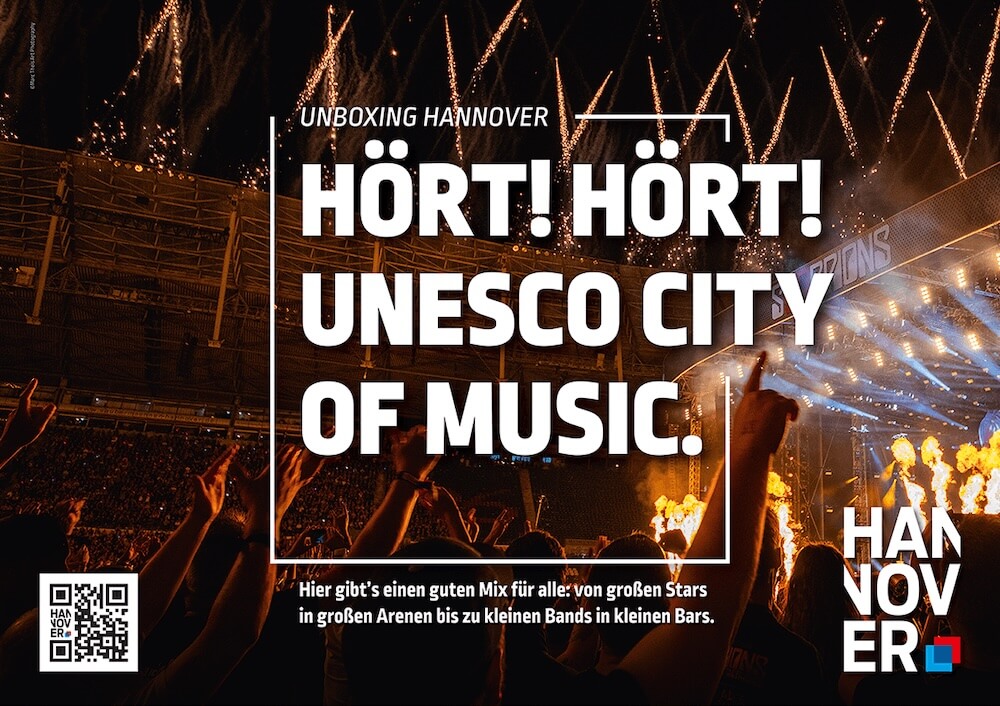
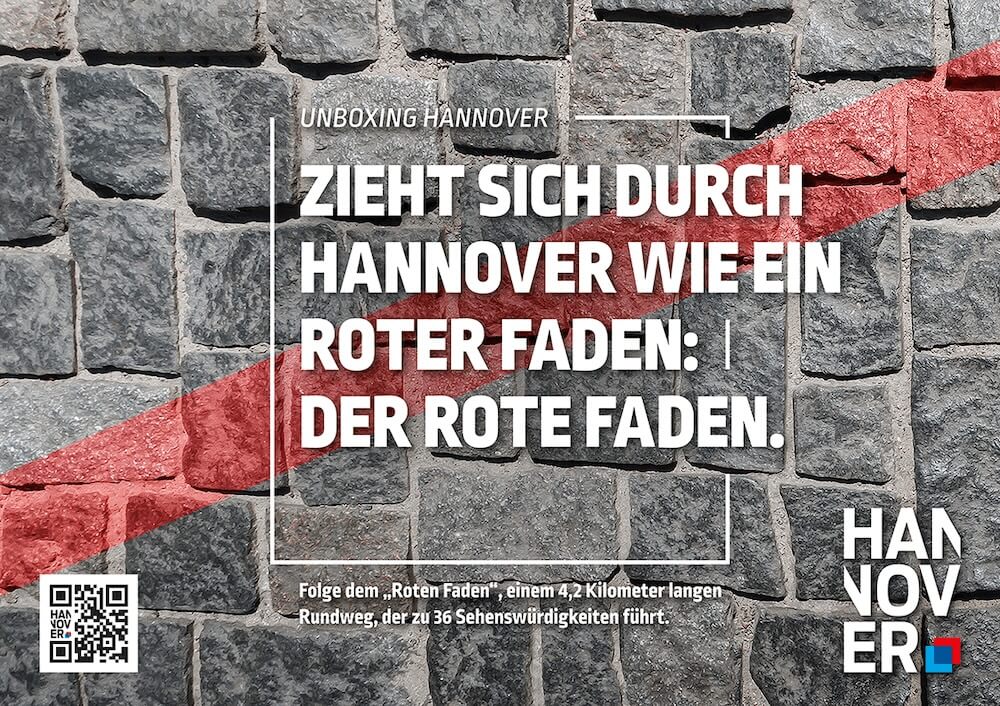
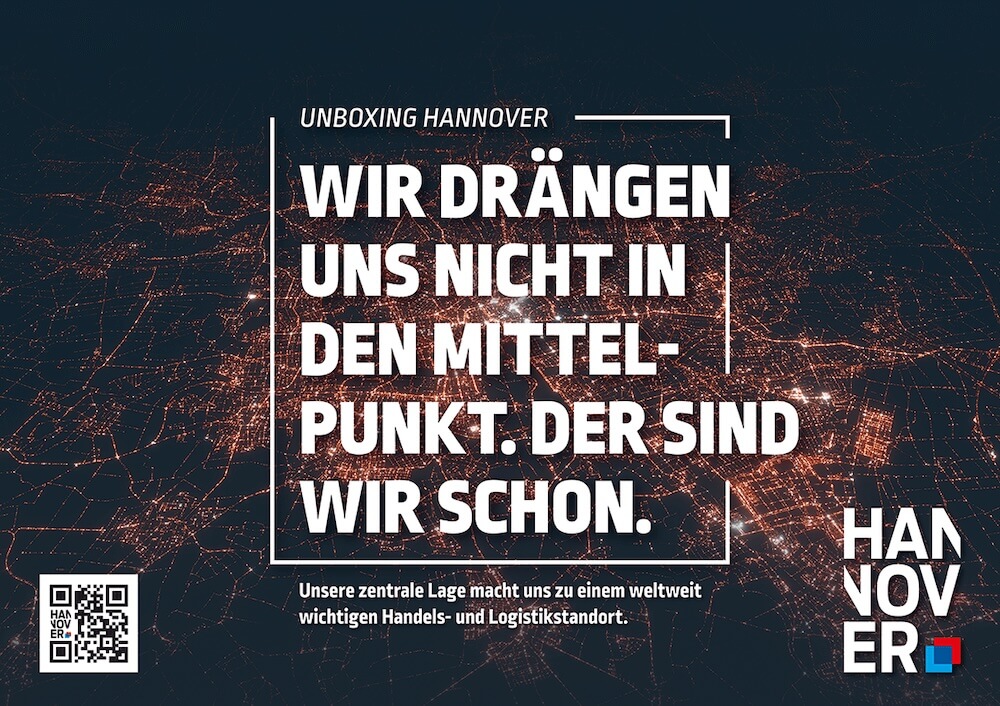
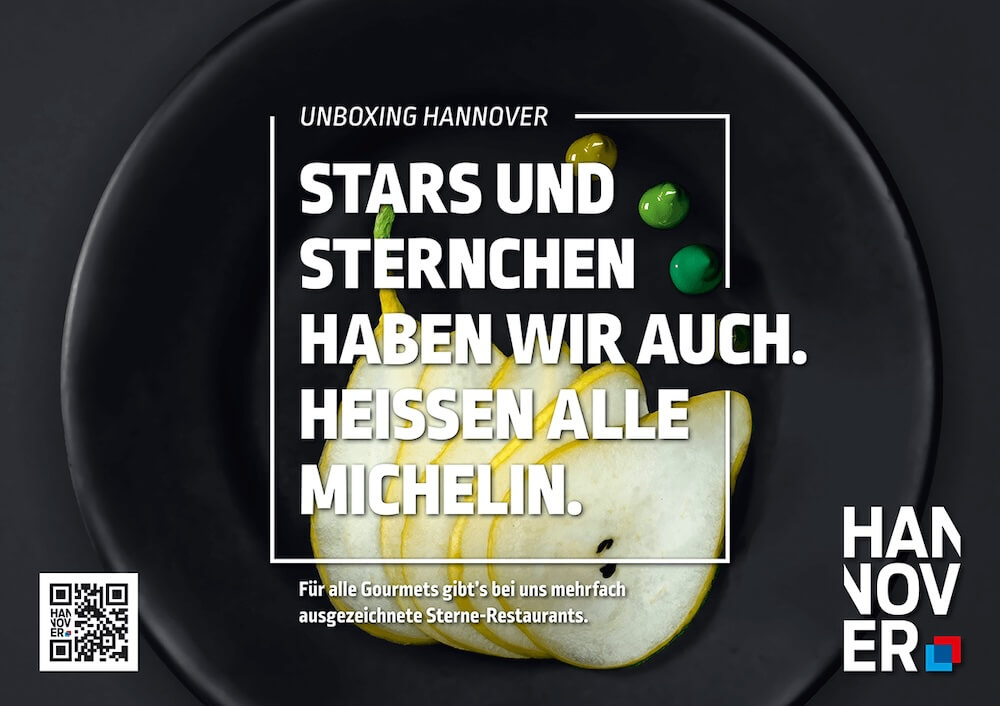
Hannover’s communication goals – implemented in strong imagery and headlines (“Unboxing Hannover”) © HMTG
Location positioning in practice: 5 principles for your city
The Hannover project is a best practice for positioning as a location. Five principles can be derived from it that make the difference in place marketing (and therefore also in city marketing):
Holistic positioning: Hanover shows how it’s done
When hard and soft factors are separated, there is a lack of connection and fractures occur. In other words: Your business communication sounds technocratic, while your guest communication comes across as emotional. The problem is that such a split communication does not contribute to the same image of your city.
Holistic positioning, on the other hand, means creating a common brand framework in which target group-specific themes can be docked without fragmenting the brand.
The “unboxing” logic from Hanover is a useful model for this: the positioning is based on Hanover’s existing DNA by making the existing strengths so concrete that they reach the target groups’ minds as experiences and images. Communication can have a formative effect, especially where an external image is not yet strongly defined. In Hanover, this is formulated as an opportunity, as the image can still be shaped.
My role as a strategic advisor in the project was to set strategic and political guidelines, bring the relevant stakeholders together and anchor participation in sustainable structures. I would like to thank my colleagues and the HMTG for the excellent collaboration.
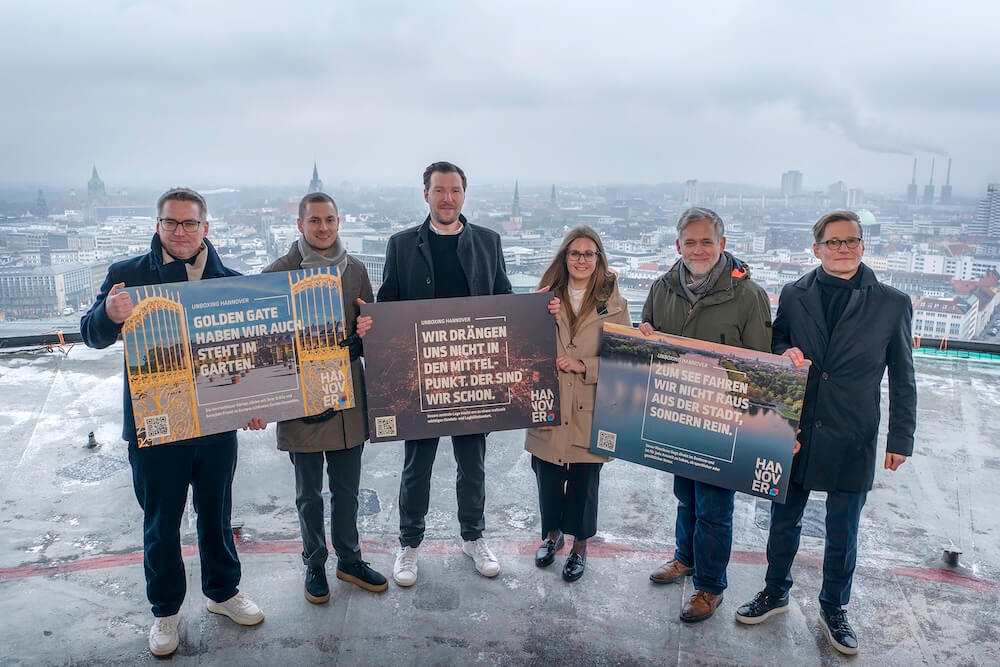
Press conference with a view of Hanover: Thorsten Kausch (2nd from right) presents the lead campaign together with colleagues from HMTG, Pahnke Hamburg and Brandmeyer Markenberatung © HMTG
Conclusion: Positioning as a strategic management tool
This understanding and the systematic approach show: Positioning is not just a communication discipline. It is a strategic management tool and helps to prioritize decisions, synchronize stakeholders, set priorities and align investments (in terms of content and communication) for impact. And it makes it possible to measure what a location should stand for.
Last but not least, positioning as a location is also hard, continuous brand work and requires a stringent management approach. This has nothing to do with a claim or logo.
Campaign credits Pahnke Hamburg:
Helge Hummel (Executive Creative Director), Alexandra Störl (Creative Director Copy), Michael Zimmermann (Creative Director Copy), Francesca Di Gregorio (Senior Copy Writer), Senjel Gazibara (Senior Art Director), Nadja Pourkian (Project Manager Media Production), Tobias Kärcher (Director Creative Strategy), Cornelius Rafael (Manager Brand Consulting)
Image credit: Hannover Marketing & Tourismus GmbH (HMTG)
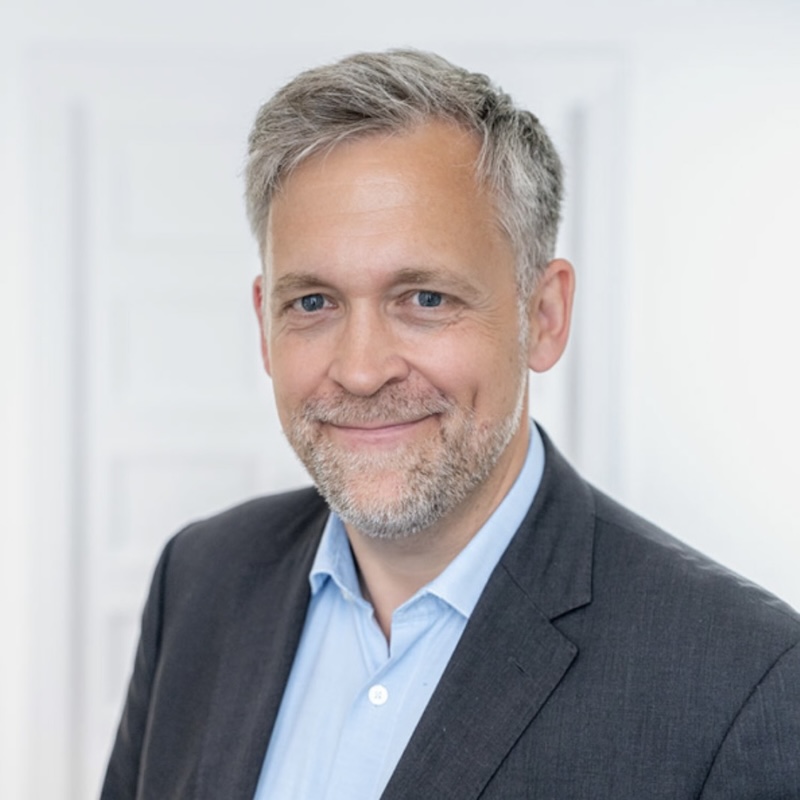
Thorsten Kausch
is Managing Director of Stadtmanufaktur and a passionate strategist, initiator and networker