CONTENT
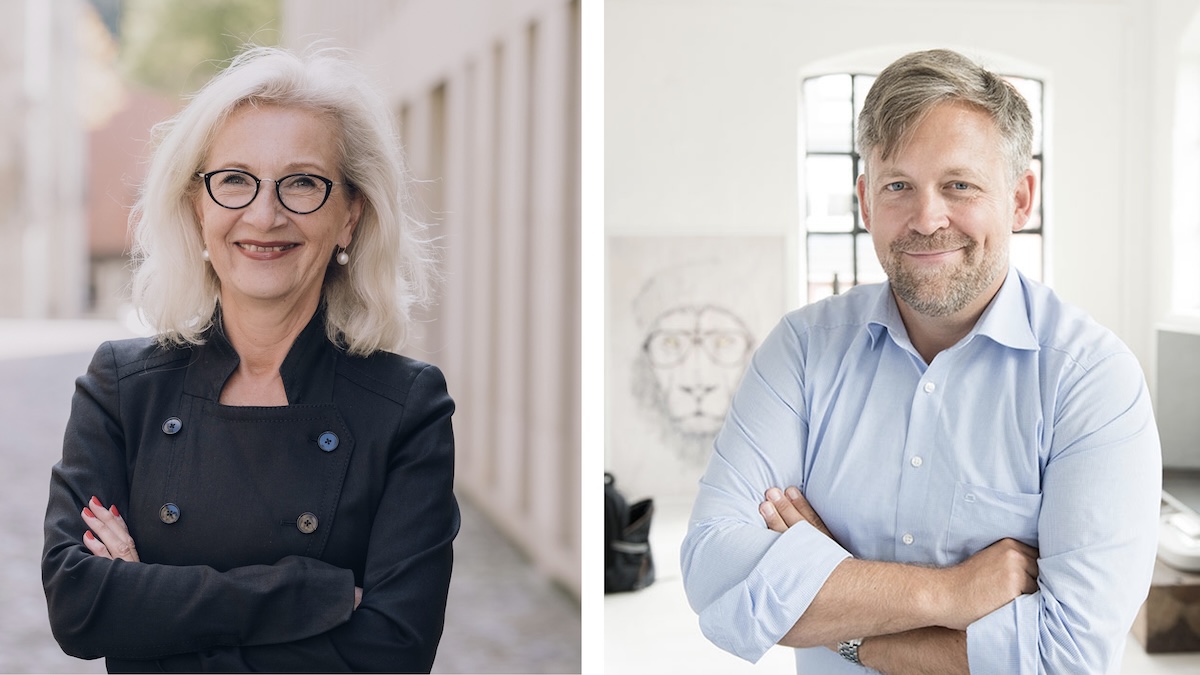
Double interview with Bernadette Spinnen and Thorsten Kausch
Bernadette Spinnen has been head of Münster Marketing since 2001. To mark her 25th anniversary, the place marketing expert meets Stadtmanufaktur Managing Director Thorsten Kausch for an interview. The topic of the hour: What strategy does a city use to develop its greatest strength internally and externally?
The experts for place branding discuss the importance of a “city profile ” – also in distinction to the city brand – and explain why the topic is relevant for all cities. Especially now, especially in Germany.
Abstract:
From the city brand to the integrated place marketing and urban development process: Bernadette Spinnen and Thorsten Kausch in an interview about how cities unite all stakeholders (politics, administration, urban society) behind an honest and forward-looking city profile – for maximum strength and radiance both internally and externally.
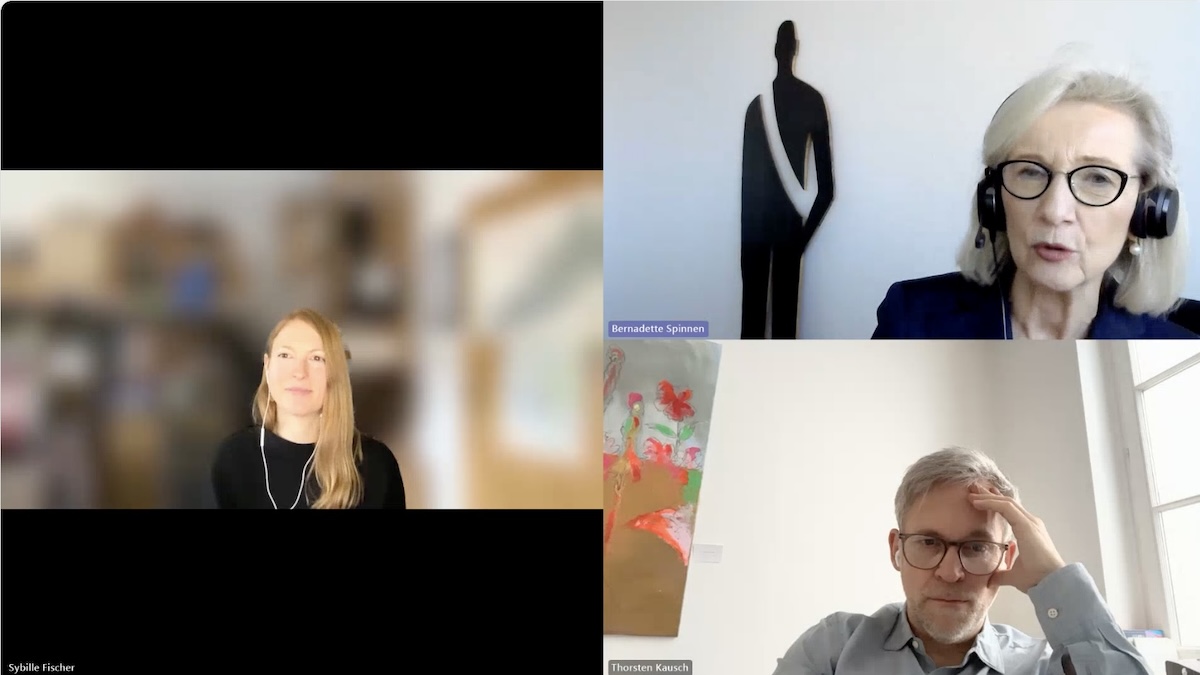
Sybille Fischer interviews Bernadette Spinnen and Thorsten Kausch via Teams on February 25, 2026
The example of Reutlingen: Why a city brand alone is not enough
Sybille Fischer: You two were recently in Reutlingen for a joint workshop – with a big question in your luggage: “What strategy does a city use to achieve its greatest impact, both internally and externally?” In recent years, Reutlingen has developed a clear brand profile, undergone a brand process and, with the Only love” campaign achieved a lot of attention. Why was the next step necessary? What was the challenge – or the gap – in Reutlingen?
Thorsten Kausch: Reutlingen initiated a very clear profiling process years ago. The city’s strengths were clearly identified: What does Reutlingen stand for? What makes the city special? What creates identity? Why do people come here, why do they stay? The city is also consistently marketed on this basis.
The challenge, however, is that if you market something, the “product” – i.e. the city itself – must also develop along these strengths. It was precisely this connection between urban development and marketing that was missing until now. There was a gap, and now it had to be closed.
Bernadette Spinnen: Reutlingen is at a point where many cities find themselves at some point after a branding process: They realize that a brand alone is not enough if it is only anchored in place marketing. If the brand only applies to place marketing and everyone else says: “That’s what they do, it has nothing to do with us”, then it can’t work in the long term.”
I like to explain this using the example of BMW and the phrase “driving pleasure”. If you delegate this to the marketing department, but the person who develops the seat thinks they have nothing to do with marketing, then the brand doesn’t work. It’s the same with cities: The brand promise must be reflected in the everyday life of the city – in the public space, in the administration, in the offerings. Otherwise it remains a facade.
That is exactly what we have tried to do in Reutlingen. And I have to say: Reutlingen has accepted this challenge as a city council. Not all cities are that far advanced. Not every city even understands that this transfer is necessary to be truly effective.
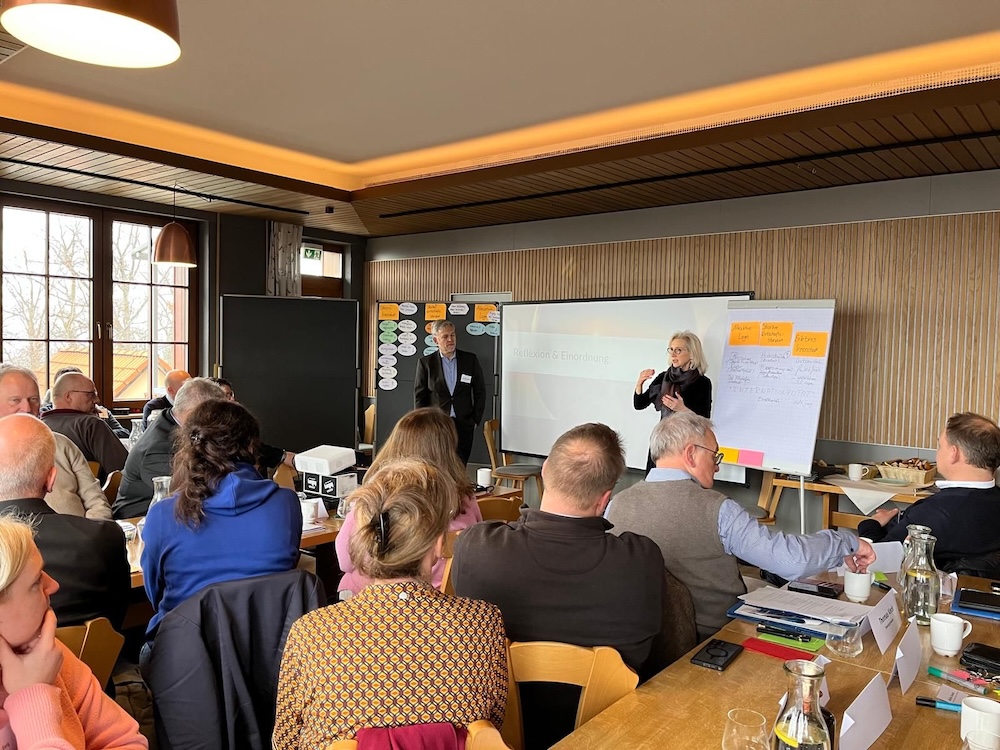
Thorsten Kausch and Bernadette Spinnen at the workshop in Reutlingen
Fischer: How did Reutlingen realize that this next step was necessary? What has shown that it needs more than the existing brand profile?
Kausch: A key issue is the budget situation. This is currently an issue in all municipalities. Public funds are becoming scarcer, which automatically raises the question: what do we want to focus on? What can, want and must we afford in the future?
This is precisely when it is important to be aware of your own credible strengths and to continue working on them. A clear profile helps to set priorities and develop decision-making criteria. That was the need in Reutlingen – also from the perspective of city politics, the mayor and mayors. The aim was to provide the administration with a framework for orientation.
Spiders: People are less and less able to bear it when no one can say where they are actually going. I can feel this search for an anchor everywhere. ach someone who says: That’s the goal. A city needs orientation – not only the administration, but above all the citizens. If they do not support this profile, do not tell it and do not fill it with life, then the process is doomed to failure.
“If the brand only applies to place marketing and everyone else says: ‘That’s what they do, it has nothing to do with us’, then it can’t work in the long term.”
What is a city profile?
Fischer: You keep talking about the term “profile” or “city profile”. What exactly do you mean by this – also in contrast to brand, mission statement or strategy?
Spinnen: For me, “profile” is the more connectable term. It describes something that I can name, that is visible and that distinguishes me from others. Some people also call it DNA.
At our workshop in Reutlingen, the participants reacted very positively to this word because it is much more common within an administration than “brand”. You can’t fool yourself: A marketing organization is often viewed critically in administrations – it is in the newspaper, does the nice things, and then the whole thing is also called a “brand”. This quickly creates distance. “Profile” is a term in which more people can recognize themselves without losing their distinctiveness. That’s how I would understand it.
Kausch: I would like to add to that. “Brand” and “marketing” are almost automatically associated with communication and sales. In theory, marketing encompasses much more – including something like product policy. Applied to cities, urban development would therefore be part of this product policy.
However, the pure sales component often remains in the image. And that is precisely the problem. It is then not understood that topics such as daycare, social issues, education, the economy or quality of life are also part of this DNA, this profile.
To differentiate it from a mission statement or strategy: A mission statement or urban strategy is usually even broader. The profile summarizes what a city wants to stand for. From there, you can move on to concrete strategies and measures. In Reutlingen, we initially worked on a meta-level: What do we want to work towards together over the next ten years, what image do we want to create of the city? The next step would then be the concrete translation into strategy.
Spiders: Nevertheless, I would never remove the brand perspective. On the contrary: it is incredibly helpful for cities because it demands an outside perspective. A city should not only ask itself what it considers important, but also how it is perceived by citizens, professionals, companies and visitors.
Why do we want to be sought after by others in the future? Why should people move here, companies settle here, guests come here? A large part of success lies in this tension between the concept of profile and the concept of brand – even if it is exhausting.
Rather listen than read?
The unabridged interview – now in the CITYMAKING podcast:
How cities find their city profile
Fischer: How do I, as a city, gain these insights from outside? How do I find out what different target groups associate with my city?
Spiders: Primarily through surveys and by comparing internal and external images. It is actually an obligation of every city to conduct regular citizen surveys – also to make developments visible over time.
Kausch: In essence, you ask a – ideally very precisely defined – target group. Who is relevant for the city? And in which regional or even international radius do you ask?
The second point is: How do you get to the right questions? This requires inner-city participation and acceptance. You can get a lot of information from the internet, but the weighting and the question of what really resonates with the local population can only be clarified locally.
Because you can’t ignore the self-perception of the people in the city. Otherwise you end up with an external image that doesn’t match the real attitude to life of those who live there. And yet you want to keep and retain these people. It always gets exciting when the internal and external perspectives diverge.
Spiders: The real task lies precisely in these gaps.
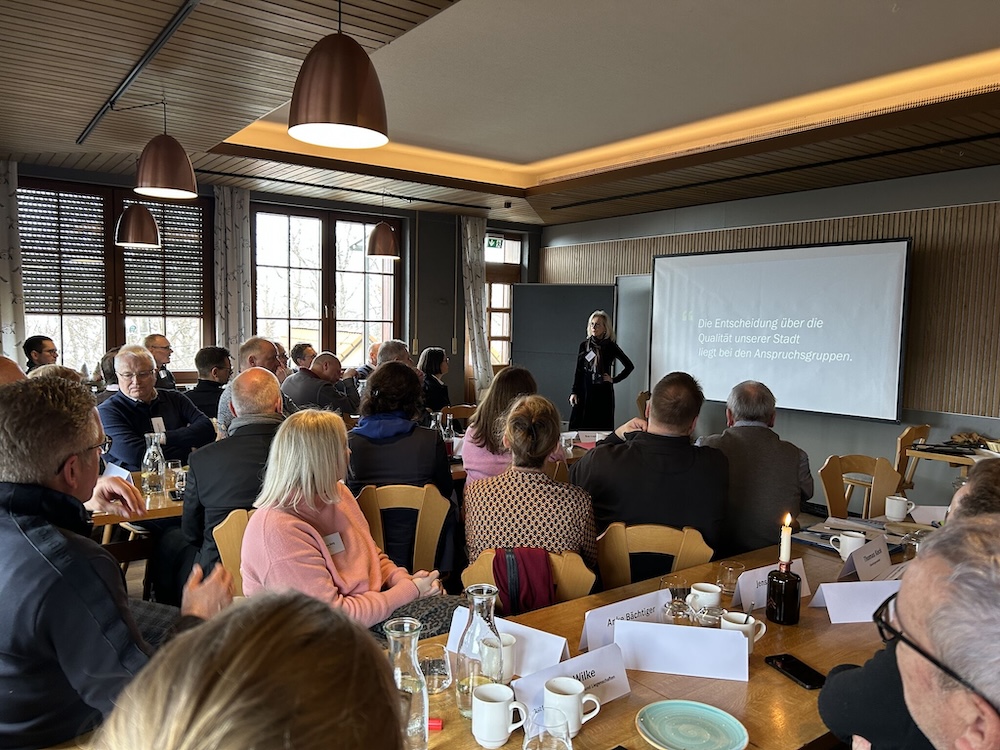
“The decision on the quality of our city lies with the stakeholder groups,” explains Bernadette Spinnen to the workshop participants in Reutlingen
How cities anchor their city profile in politics and administration
Fischer: Once I as a city have developed my city profile – i.e. the approach to internal and external perspectives and perhaps also a vision for the future: How do I anchor it organizationally in such a way that it actually works in the everyday life of the city?
Kausch:
I would like to take another step in between. After all, a survey initially gives you a picture of the current situation. But it only becomes really helpful if you combine it with a target picture – in other words, with the question: Where do we actually want to go?
That was precisely the step we took in Reutlingen. We already had a clear analysis of our strengths. What was missing was a forward-looking perspective: how do we want to work with these strengths in five or ten years’ time? Are they still the right strengths? Do they need to be adapted? Are they credible enough?
Once these questions have been answered, the next decisive step is to not only think ahead within the administration, but to involve the entire city. Which stakeholders are needed to fill this target image with life? The city sets the framework – but what happens between the buildings, on streets and squares, in daycare centers, in institutions, in companies and in voluntary work is done by people who actually live the city. These people and institutions now need to be involved and an overall narrative needs to be developed.
Spiders: It’s a long ride. And it’s not as linear as textbooks like to portray it. A city administration is also never as controllable as a company. In a city, political, institutional and social forces work together, sometimes even against each other. That makes things more complicated.
This is precisely why the first step should not be to define what we think is great, put it in the shop window and then keep talking about it. It doesn’t work like that. You have to take a very close look at this first image and wrestle with whether it is really true.
That’s exactly what we did in Reutlingen: we worked on a few sentences and a few areas of strength – and very precisely. Again and again, the question was: Is this right? Is it credible? Does it suit Reutlingen? At the same time, of course, you can’t pretend that a city only consists of three themes. But a city doesn’t advertise with a thousand facets, but with two or three.
The crucial first step is therefore to consolidate this image to such an extent that the broadest possible consensus emerges and people say: yes, this feels right. If that doesn’t happen, even the best implementation logic won’t help in the end.
Focus instead of diversity: Why cities need clear priorities
Fischer: A city therefore needs empathy, honesty and a vision. But how do I end up with exactly two or three areas of strength?
Kausch: Normally, the analysis already leads to specific areas of strength. And then it takes self-reflection and courage. The art of sharpening your profile is not to want to be everything you would like to be, but to ask yourself self-critically: What can we really do? Where are we credible? This is precisely what creates a profile that also carries to the outside world.
Especially when resources are becoming scarcer, it is important to be aware of your own credible strengths and to continue working on them. A clear profile helps to set priorities and develop decision-making criteria. This is precisely what is of great value to cities today.
“The art of sharpening your profile is not to want to be everything you would like to be, but to ask yourself self-critically: What can we really be? Where are we credible? This is precisely what creates a profile that also carries to the outside world.”
Fischer: The process therefore has an emotional and an economic perspective. It is also about what idea of the future the city profile carries?
Spiders: The central question is always: How do I want to be perceived by certain target groups in five or ten years’ time? What can I actually achieve? And what do I have to do to achieve this?
That is really important. Citizens are often very critical of their city – and rightly so. If you promise them something that they think is nonsense, that we can’t do it, then they won’t go for it.
I would like to give you an example from Münster. In the sports committee, I was told several times that there was too little sport in our profile. At some point, we discussed it together and then we said: “We want to become a volleyball city.” Then came the uncomfortable questions: Do we have the space? Can we host big matches? Do we have the infrastructure to make us visible as a volleyball city even when a club is weaker? You quickly realize that aspirations and reality have to go hand in hand.
In the end, we landed on the formula “Münster is a city on the move”. That was coherent. It fitted in with the city’s themes – and also with the city of science.
“Especially when resources are becoming scarcer, it is important to be aware of your own credible strengths and to continue working on them. A clear profile helps to set priorities and develop decision-making criteria. This is precisely what is of great value to cities today.”
How the city profile becomes effective in the city
Fishermen: Once the areas of strength have been found: How do I, as place marketing, ensure that they are not just on paper, but actually become effective in administration and urban society?
Spiders: The most important person here is the Lord Mayor. If he or she does not support the city profile and does not repeatedly refer to it in speeches, papers or budget speeches, then it will not be credible. The more people from the administration who go along with it, the better. They don’t have to learn it by heart – but if the profile is right, they will live it.
And I always think it’s excellent when you really discuss this with the key stakeholders in urban society and take them along on this journey. Because a city does not live through its administration alone.
Kausch: Citizens also want guidance. They want to know where to go. And they notice very clearly when a city has no claim. Then they leave at some point.
Spiders: At some point in Münster, we also realized that we were neglecting the city districts because – like many – we were focusing heavily on the city centre. At the same time, we had neither the money nor the staff to be active in all districts. So we launched a district promotion competition.
We asked the districts to develop their own marketing concepts for their neighborhoods – following a similar pattern and docked to the city profile. That worked fantastically well. The ideas that came up were completely original, lively and funny, and many of them still live on today.
There were clear conditions: All clubs were to be involved, not just individual players. It had to go through the district councils, which had to contribute a small amount themselves. This resulted in a genuine joint process. The potential for identification is enormous in the districts in particular – and it worked extremely well there to connect with the city profile.
Rather listen than read?
The unabridged interview – now in the CITYMAKING podcast:
Why the topic of city profiles is now important for all cities
Fischer: Why is this topic so important for cities right now? Why should every city that hears or reads this say: This is the way we have to go now?
Spiders: It has several answers to this. The most banal one is: in view of the debates about money in cities, the question will arise very dramatically as to how much place marketing cities can or want to afford at all. And this will also raise the question: Why do we need place marketing at all?
“In view of the debates about money in cities, the question of how much place marketing cities can or want to afford will arise very dramatically. And this will also raise the question: Why do we need place marketing at all?”
Spinnen: I also believe that it is part of a mayor’s job description to say where he or she wants to develop the city and what should be worked on together. At the latest then the question arises: How do I even get to these topics? This is not just a gut feeling and not just an election campaign, it is the tangible bread-and-butter business of administration, politics and urban society.
And thirdly, urban development no longer works without the communicative dimension. You have to develop the city together with the people – and at the same time make a promise to the outside world. At the moment, there are really only good reasons to focus on this.
Kausch:
Nothing to add, as they say.
Fischer: Thank you very much for your time and for your insightful answers. And good luck for Reutlingen, Münster and all the other cities.
Image credit: Meike Reiners, Stadtmanufaktur
Sybille Fischer
develops narratives, concepts and communication for cities – and for Stadtmanufaktur itself.