CONTENT
Best time—or worst time?
When I was commissioned to found Münster Marketing more than 25 years ago, issues such as competition among cities and a city’s appeal to target groups—including businesses and other (affluent) visitors — were the driving forces and setting the pace for place marketing. The principles of business marketing were seen by many as a savior and a source of modern hope within our cities’ local governments and city councils, which were perceived as outdated and inefficient.
A quarter-century later, a number of misconceptions and expectations have dissipated—or changed—and the persistence of the (old) systems is recognized as a serious factor in any transformation. Moreover, our world and the challenges it presents have changed so dramatically that even place marketing—which is as sensitive as a seismograph—has long since become something else entirely. At least where it has paid close attention.
Actually, this is a good time to start thinking about the future of place marketing right now. Now, when local governments in particular are under greater economic pressure than ever before. Now, when democracy at times seems to be fading away and must be constantly praised and reinforced. Now, when people clearly can no longer keep up with the complexity of the world. Now, when every voice demands to be heard always and everywhere, and when conflicting goals regarding every aspect of our coexistence in cities are placing a dramatic strain on the community and the public sphere. Now, when safety and security are among the most prominent responsibilities of our cities.
And at the same time, of course, it’s the worst possible time to talk about the future of place marketing. At least, if you’re anxiously worried about your livelihood. But that’s not an issue at all in place marketing. Thinking about our contribution to the community, striving every day to maintain our relevance, and proving it goes without saying for us—and it’s also a highly exciting challenge.
So what can—and what should—place marketing of the future be? And I’m deliberately phrasing the question this way, based on the city’s needs rather than on the topics place marketing would like to focus on.
Abstract:
Bernadette Spinnen has been the director of Münster Marketing since 2001 and served for many years as national chair of the Federal Association of Place Marketing in Germany (bcsd). In seven theses, the expert ventures a look into the future of place marketing. To this end, she analyzes where the greatest challenges currently lie and how place marketing will—or must—change.
1. City Brand and City Profile
Now more than ever, people need guidance and a space where they can define themselves. Where is the city I live in headed? Why should I choose this city? As a tourist, as a business, as a professional working for a company, or as a resident?
Especially in a completely individualized world, people need a clear picture in order to find their bearings and feel at ease. After all, public institutions and the political system are often accused of floundering aimlessly—and not without reason.
Place marketing is responsible for the ongoing work on the the city’s profile the expert, and above all, the host and curator. But keep in mind: The city profile is not the same as the city logo. The city profile is the city’s DNA, from which the city’s strategy can be developed.
In the future, place marketing must do even more to ensure that the so-called city brand is integrated into administrative practices and is given concrete expression every day in the work of the administration and in city policy: in construction site management as well as in urban design, in the social services department as well as in the cultural affairs department, in transportation policy as well as in climate policy.
There’s no question that positioning cities in this way poses a major challenge in a political climate that is extremely diverse and tense. No city leadership can really afford to shy away from this challenge. Place marketing has the expertise and tools to develop the city’s goals in collaboration with citizens, the city council, and the administration—and, above all, to communicate them in a way that people can understand—through a wide variety of methods and channels.
Thesis 1:
Brand processes must be integrated into administrative practices so that they can credibly align municipal actions with the city’s goals.
2. City Centre and Downtown Management
We’ve all talked so much about citizen participation that, at least behind closed doors, doubts about its effectiveness are being voiced on all sides. Now is not the time to throw the baby out with the bathwater!
Unless we allow people to participate in municipal decision-making and actively involve them, we will become entangled in conflicting goals and will no longer be able to make any progress.
Place marketing can also play a role here: Successful place marketing organizations are networks. They do not operate in isolation like individual municipal departments, but rather draw their strength, their content, and, in most cases, their budgets from their thematically focused partnerships:
- In city management, place marketing is connected to all downtown stakeholders—and usually in person (!) ;
- in the tourism industry with all service providers and many other partners,
- in science communication with universities, and the list goes on and on.
This work ethic is needed now, as these examples show:
- Construction site management that draws on city management practices in direct stakeholder communication can communicate more effectively and prevent the notion of government failure from appearing to be proven correct on a daily basis.
- A street in the city centre that vulnerable groups have chosen as a nighttime gathering place or that they frequent daily has a strong ally in the place marketing department, whose communication skills help bridge the gap between the administration and law enforcement agencies.
- And getting property owners to come out of their shell and become partners in city centre development is also a matter of good personal relationships and close ties to both municipal institutions and private stakeholders alike.
Thesis 2:
Place marketing is needed—both now and in the future—as an intermediary between local governments and private entities.
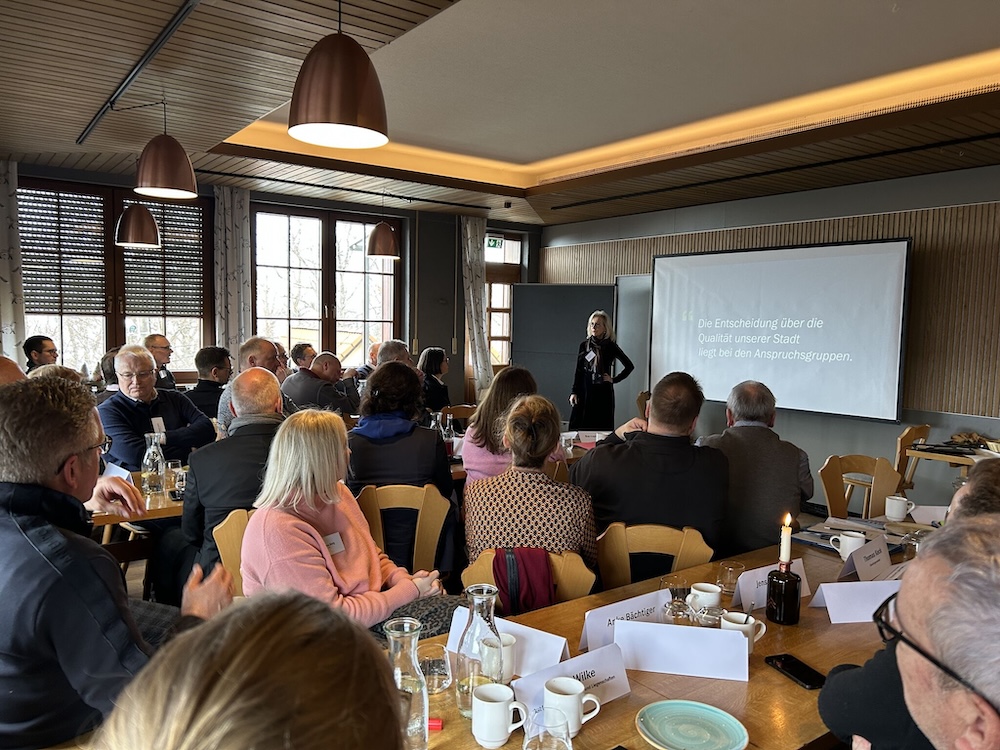
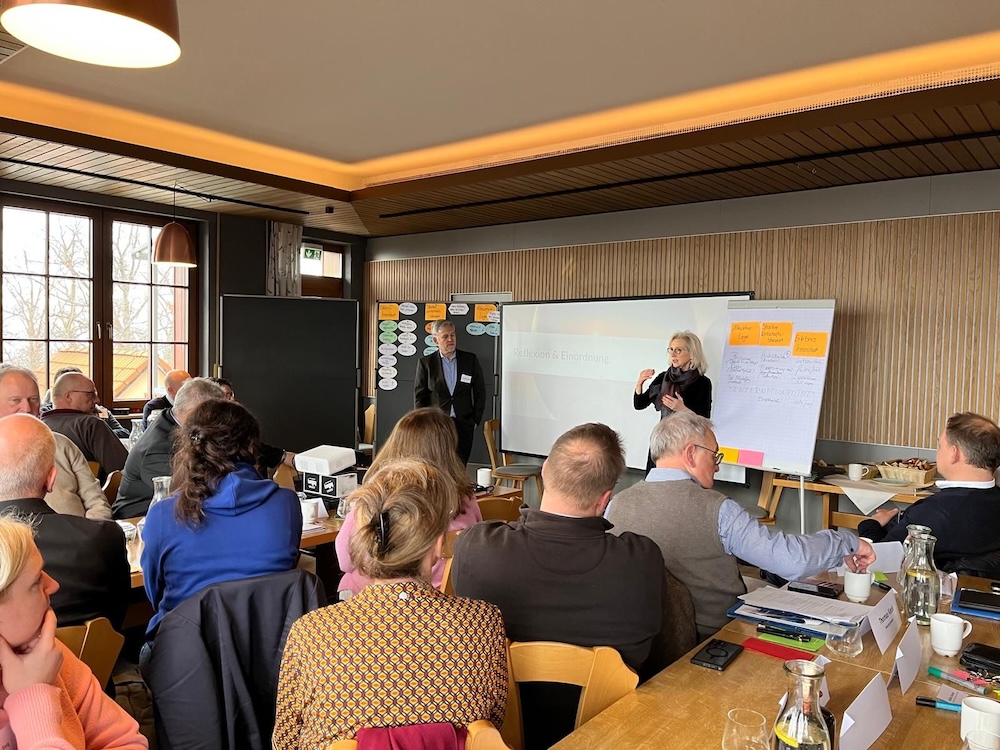
Bernadette Spinnen also shares her insights and knowledge with other cities—here at a workshop on city profiling in Reutlingen
3. Civil Society and Volunteer Work
Our municipalities are clearly reaching the limits of their capacity. As a result, it is becoming increasingly evident with regard to important projects that do not fall under so-called mandatory responsibilities: Either we get citizens on board as responsible stakeholders, or we cannot make the offer!
This applies to the organization of neighborhood and district initiatives, to downtown management, but also to urban green spaces, drinking fountains, and other aspects of public space. Often, there are enough people who want to get actively involved. But they still need help and support with management, such as in dealing with government agencies. Place marketing, with its experience in stakeholder management, can also be an important partner here and can help and provide motivation, at least in the initial phase of building these structures. It goes without saying that securing financial resources is also part of this process.
Thesis 3:
Working with civil society on issues relevant to the city will become a key task of place marketing. It engages citizens, turning them into active participants and (brand) ambassadors for their cities.
4. Public Space—The Living Room and a Calling Card
The distinctiveness of cities, their ambition, and their character are realized in public spaces. In the urban landscape, everyone comes to understand who this city is, what matters to it, how rich or poor it is, how hard it is striving, or whether it has given up. The city is discussing its visibility in public spaces.
Place marketing, as a communicator and creator of urban imagery and narratives, must in the future establish itself even more firmly as a coordinator for issues related to public space. The much-cited “quality of stay” depends on many small details: green spaces in the city, seating areas and attractive street furniture, the city’s lighting design and evening activities, the availability of cool places to relax, and—most importantly—safety and cleanliness.
Developing all these individual specialized topics into a cohesive and appealing whole is a challenging task for the future. To achieve this, place marketing must further expand its communication and coordination capabilities and bring a big-picture perspective to the decisions made by the individual disciplines. The same principle applies here as for strong downtown management: It requires a natural alignment with planning and urban development, but also with the key municipal departments whose decisions affect the urban landscape.
Thesis 4:
Efforts to improve the city’s design and the quality of public spaces will become an even greater focus of place marketing and will challenge its ability to coordinate these efforts
5. Digitalization and AI
No vision of the future can be formulated without taking into account the disruption caused by digitalization and artificial intelligence. Many highly paid speakers are currently taking to the stage across all disciplines to offer a glimpse into the future—or, one might say, into a crystal ball. I’m skeptical about the validity of all these expert opinions.
It seems certain to me, however, that the widespread use of AI in every aspect of our daily lives will change everything. Our society has every reason to be deeply concerned, As for the as-yet unforeseeable consequences of this change, we will not be able to stop it—and whether we can cope with it remains to be seen.
I see two directions for change in place marketing: In the area of tourism and convention marketing People’s booking and information-seeking behaviors will threaten our offerings and further reduce our already limited sources of revenue. In light of municipalities’ dwindling financial resources, we will be faced with the question of what tasks a municipal tourism agency must fulfill and what these services may cost. Defining our undeniably necessary contribution to the prosperity of an attractive tourist destination will be a task that must be completed with dramatic urgency.
At the same time, the ever-increasing digitization of our lives will, on the other hand, give rise to a strong desire among people for an analog urban experience—for an atmosphere that is as unspoiled and unique as possible, and for beauty that is simple and accessible. With our expertise and experience in bringing public spaces to life, we in place marketing are the experts in this field.
Thesis 5:
The experience of this vibrant city will shape the expectations of both locals and visitors. As experts in the use of public spaces, place marketing professionals must anticipate people’s desires, make them visible, and act, in a sense, as “wish-makers.”
6. Visitors to the City as Temporary Residents
It is now widely recognized, at least in professional circles, that the distinction between tourism marketing and place marketing is an artificial one. The qualities and unique characteristics of the city—and, of course, to a large extent, its city centre—provide the subject matter for tourism communication, the content of which cannot and must not differ from that of place marketing.
In urban tourism, the focus now and in the future must be on highlighting, strengthening, and showcasing the recreational qualities of cities in a way that benefits both residents and visitors: both groups need communication that is as accessible as possible—both digital and analog—and tailored to all target audiences.
Thesis 6:
Turning visitors to the city into temporary residents will become the goal of urban tourism. Integrated tourism concepts are derived from this requirement and serve as the standard for every city.
7. Finance and Organization
Any discussion of the future of place marketing must take local government finances into account. And there is little cause for joy or hope in this regard: Budgets are shrinking everywhere, municipalities are scrutinizing every discretionary expenditure, and are consolidating their holdings to reduce personnel and material resources. In almost every city, even the smallest changes are sparking discussions about mergers , which typically affect place marketing organizations and economic development agencies—and sometimes even convention centers and tourism organizations.
As regrettable as this may be in individual cases, it does not have to spell the downfall of our disciplines and their quality. And that is something truly worth fighting for:
Place marketing is not a subdivision of the economic development department. Place marketing takes into account all of the city’s target groups and issues, both internal and external—while the economic development department’s focus is reflected in its name.
A collaborative and professional relationship with economic development and urban planning is essential for successful place marketing efforts that go far beyond promoting the city as a business location. Regardless of how organizational structures are designed in individual municipalities, they should reflect this hierarchy of priorities.
Thesis 7:
Economic Development, the Convention Center, Tourism, and Place Marketing work hand in hand. Each city must decide for itself whether these departments should and can be merged administratively. It remains important to take thematic hierarchies into account in all merger efforts.
Conclusion: Now is the best time
If you ask yourself the honest question about the sustainability of place marketing—from the perspective of a practitioner, of course—a consistent picture emerges:
To ensure that we, as a place marketing organization, can provide solutions to these issues and challenges, we recommend: a clearer definition of our profile, the professionalization of all areas of work, and demonstrating the highest quality of our staff. This quality check is carried out anew every day by our citizens!
Focusing on our core competencies is an indispensable prerequisite for this: We work across sectors and across all subject areas, and we always work in networks—with the administration, stakeholders, and residents—and see ourselves as intermediaries loyal to the city. In my view, the values and character of place marketing stem from this self-image.

Bernadette Spinnen