CONTENT
After the election is before the work begins
New majorities, new mayors, and newly constituted city councils—the 2026 local elections will bring negotiations over political priorities and raise expectations for change. In many places, this political fresh start is met with considerable pressure to act: city centres are changing, housing is becoming scarce, mobility is a constant source of political contention, household budgets are under strain, and entire economic hubs must reinvent themselves.
As we all know, the real work doesn’t begin until after the election: Political goals must be turned into priorities—and priorities into concrete changes.
It’s important to note that in our projects, we see time and again that the crucial question after an election isn’t “What do we want to change?” but rather “Which of these changes is actually feasible given the specific conditions of this city?”
So how does this political momentum actually lead to change?
From our work with local governments, we know that the first 100 days of a new term aren’t enough to reinvent a city. But they are enough to provide direction, set priorities, bring people together, and visibly get things off the ground. We want to support local governments in this regard:
- We have identified five areas where it is now particularly important to move from intention to action.
- We’ve identified five key questions that every city should ask itself after the local elections.
- And with the STADTKOMPASS, we show how these questions can be turned into a concrete agenda for the first few months of the new term.
Abstract:
Following the 2026 local elections, new political majorities will face significant pressure to act: city centre areas, growth and transformation, mobility, tight budgets, and an increasingly fragile urban community. Sophie May shows what course local governments can set in the first 100 days—and how the STADTKOMPASS helps them turn a multitude of tasks into clear priorities and next steps.
From the city centre to Urban Society: 5 Issues for the First 100 Days After the Election
1. Reinvent the city centre—and not just in five years’ time
For many municipalities, the city centre remains one of the most visible political issues. Vacant properties, changing shopping habits, the restaurant industry under pressure, declining foot traffic—and at the same time, high expectations regarding quality of life, culture, and social interaction: In many places, the traditional city centre can no longer rely solely on retail to function.
At the same time, vacant properties are becoming a visible symbol of change. One storefront stands vacant. Then two. Then three. The first owner is still waiting for a new retailer. The second doesn’t want to rent the space below market value. The third property has been vacant for years because the intended use isn’t feasible under building codes or economically viable.
So the question isn’t just: How do we fill the vacant spaces again? It’s: What kinds of uses does this place need, and how do we bring them there?
An experience from our work illustrates just how complex this question can be: In a city with a population of about 20,000, the mayor wanted to facilitate new retail and service offerings at several locations. Can a new shopping center on the outskirts of downtown actually strengthen the city center? Or will it draw away exactly the foot traffic that is urgently needed there? Can an additional grocery store truly fill a supply gap, or will it drive out an existing provider?
There’s also a very practical question: How do we actually start a conversation with the providers, owners, and other stakeholders we need for this development? The key is to bringing the right people to the right table. This is exactly where urban development becomes relationship-building—and stakeholder management becomes a central tool of urban development.
Topic: City Centre—What Can Be Achieved in the First 100 Days
Our approach for the first 100 days after the election: Identify three to five particularly relevant sites or vacant properties, bring the key stakeholders together, and agree on a specific next step for each site.
2. Shaping Transformation Strategically
What is the city’s vision for the future, and how can this be translated into a feasible development strategy given the current circumstances?
Many municipalities want to grow. More residents often mean more demand, more tax revenue, and, in the long term, greater economic vitality. At the same time, this also entails costs: housing, daycare centers, schools, roads, public transportation, social infrastructure, and public spaces must keep pace with this growth.
It is therefore crucial to determine what kind of growth and development are appropriate for a city. While some municipalities want to attract new residents and create housing, others are struggling with an aging population, vacant properties, and declining population numbers. Industrial cities, in turn, must reposition themselves economically.
In all cases, the issues at stake go beyond individual areas or projects. Housing, the economy, infrastructure, energy, the city centre, skilled workers, and the city’s image are all closely interlinked. New opportunities for action—for example, in housing construction and local supply—simultaneously increase the pressure to make decisions.
A clear city profile can provide guidance here by addressing key questions in a strategic and long-term manner:
- What kind of city do we want to be?
- Which target audiences do we want to reach?
- What types of uses and locations are suitable for this?
- How can this profile be incorporated into specific decisions and across the various areas of the administration?
Comparing Cities – Different Starting Points Call for Tailored Solutions
Our clients and projects in Walldorf, Gelsenkirchen, and Lünen demonstrate just how different the starting points can be in German cities.
Example: Walldorf
The city of Walldorf in Baden-Württemberg is economically very strong, yet there was a need for action to more closely integrate place marketing, the city centre, and social cohesion.
Our solution for Walldorf: Together with various city stakeholders, we developed a city marketing concept that brings together activities that strengthen the city centre and make the city’s qualities more visible.
Example: Gelsenkirchen
Gelsenkirchen, in the Ruhr region, on the other hand, is facing a more fundamental transformation: There, a great need for action is met with limited financial resources. Added to this are very low purchasing power and intense competition with surrounding cities.
Our response for Gelsenkirchen: In Gelsenkirchen, it is essential to identify, within a strategically guided transformation process, those projects that can have the greatest possible impact with manageable resources.
Example: Lünen
And sometimes the situation is exactly the opposite: A city receives the investments and attention it has long awaited—and suddenly has to implement changes much more quickly than its existing structures are accustomed to. This is exactly what Lünen in Westphalia is facing. There, numerous interconnected projects are taking shape as part of the IGA 2027.
This is what matters now in Lünen: To ensure that the Future Garden benefits the entire city, urban development, mobility, events, tourism, dining, retail, communication, and the urban community must all work together.
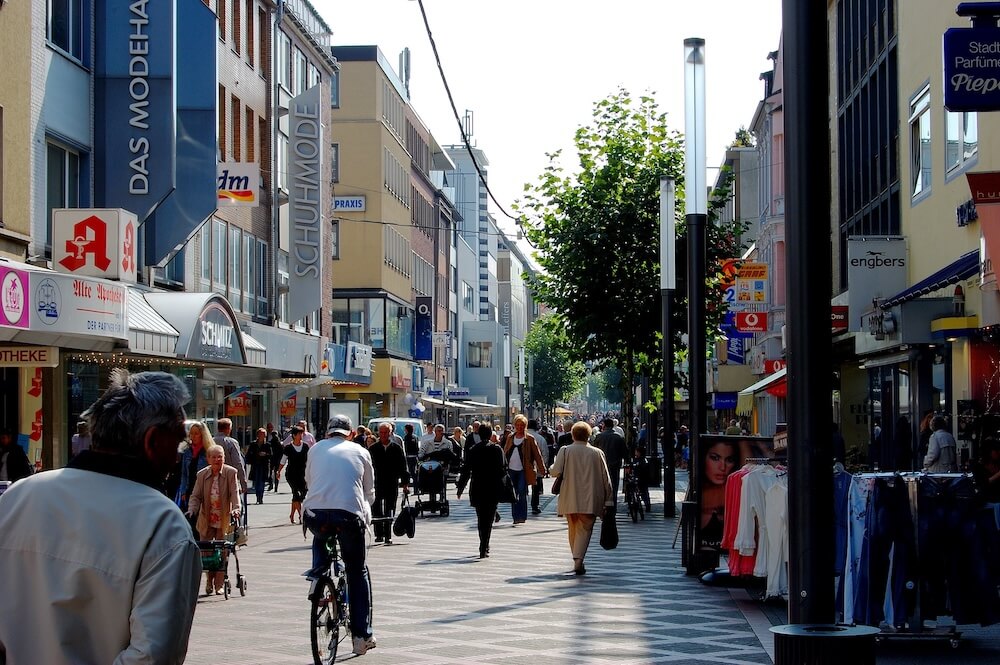
Significant Pressure for Transformation in Gelsenkirchen—Especially in the City Centre
Transformation requires priorities—and capacity
Smaller municipalities, in particular, face a different challenge: they often lack the necessary resources. Not every city has its own economic development office, place marketing department, grant office, and project office. A project idea arises, a funding opportunity is identified—but who will write the application, coordinate the partners, and oversee the implementation?
Municipalities in Lower Saxony receive support from the pool of experts in the “Zukunftsräume Niedersachsen” funding program. Municipalities can take advantage of up to six days of consulting services per year to develop eligible projects; we, too, are part of this pool of experts.
Topic: Transformation—What Is Possible in the First 100 Days
Refine a shared vision for the future, evaluate current and planned projects against that vision, and identify three to five key projects that are particularly relevant to the desired development and can be realistically implemented under the existing conditions.
3. Turn the issue of traffic into an urban development project
Few issues are better suited to dividing people along political lines than transportation: cars versus bicycles, parking spaces versus quality of life, public transit versus private vehicles. A question about how to design a street space can quickly turn into a fundamental debate about the future of the entire city.
It’s worth taking a step back and asking: How should this city function in ten or 15 years, and what do people need to make that happen?
Key insight: Needs underlie positions
Taking this bird’s-eye view offers a fresh perspective on the discussions in participatory and dialogue processes. Behind seemingly irreconcilable positions often lie very specific needs: the retailer needs customers, the resident needs accessibility, the child needs a safe route to school, the restaurant industry needs a pleasant atmosphere, and the commuter needs a reliable way to get to work.
Those who focus on these functions and needs rather than on modes of transportation are more likely to create a common foundation for change.
Our experience shows that people are rarely fundamentally opposed to change. Instead, resistance often arises when people feel that decisions are being made over their heads. This is precisely where effective facilitation and dialogue are needed—to bring different interests to light and translate them into shared goals.
From Traffic Conflict to a Shared Urban Landscape
Our takeaway: Transportation should not be planned in isolation, but rather conceived as part of the desired urban landscape. For new city leaders, this means first developing a shared vision for mobility and then deriving a few high-profile, key projects from it.
Transportation: What Can Be Achieved in the First 100 Days
Especially during the first 100 days, the goal is not to completely reorganize all traffic, but to transform a deadlocked conflict into a collaborative urban development project.
The necessary steps to achieve this are: bringing to light the underlying interests and needs, developing a shared vision, and agreeing on a concrete first step or pilot project.
4. A budget crisis also means deciding what won’t be done
Perhaps this is one of the most difficult tasks facing a new city administration: Expectations are high, but the financial and personnel resources are limited. Schools, bike paths, city centres, sports facilities, climate adaptation, and housing are all on the political agenda—yet in many places, the funds are lacking to tackle everything at once.
Oldenburg illustrates just how great this tension can be: The approved 2026 budget shows a projected deficit of around 69 million euros, while investments totaling 127.4 million euros are planned (source: oldenburg.de).
Important To-Do: Review, evaluate, and prioritize projects
In our work, we rarely run into a shortage of ideas. Local governments have strategies, plans, grant applications, policy decisions, and numerous project ideas. The key question is rather: What is truly important, and what can the city actually accomplish with its existing resources?
That’s why, especially during the first 100 days, it can be helpful to lay out all current and planned projects and review them together (see the questions in the box below). A municipality can approve ten projects. If staffing resources are sufficient for only two, ten projects will ultimately be implemented slowly.
Prioritization is therefore always an organizational decision: Where should time, money, and personnel resources be targeted?
Topic: The Budget—What Can Be Achieved in the First 100 Days
Put all current and planned projects on the table and review them together:
- What has the greatest impact?
- What is urgent and financially feasible?
- Where can we see results in the short term?
- Given limited capacity, what will have to wait for now?
The end result should be a clear list of priorities consisting of just a few projects on which resources and attention can be specifically focused.
5. A city needs infrastructure—and a civic community to support it
One trend we’re seeing more and more in many communities is less visible than an empty storefront: the active urban community itself is dwindling. Volunteers have been giving their time for decades, and at some point, the next generation is missing. Clubs can’t find successors for their boards; fire departments and sports clubs are struggling to recruit new members, and event organizers are struggling to find volunteers. At the same time, security requirements, regulations, and personnel and security costs are rising for events. What used to be taken for granted is thus becoming increasingly costly and, at times, simply no longer financially viable.
This poses the risk of a gradual loss of what makes cities vibrant: festivals , markets, clubs, community groups, neighborhoods, and gathering places.
When Commitment Becomes a Scarce Resource
That’s why, in discussions about revitalizing downtown areas, we often hear the suggestion: “We need to organize more events.” Our response these days is often: “Who should organize them, and who can still afford them?“
Local governments cannot and should not organize every event themselves. Rather, the goal is to create better conditions that enable people to get involved. This may involve streamlining approval processes, providing venues, connecting organizations and initiatives, securing sponsors, or sharing responsibility among multiple parties.
At the same time, the forms of engagement are changing. Many people prefer to get involved on an ad hoc, project-based basis: helping out at a city festival, organizing a pop-up event, temporarily using a vacant space, or getting involved in a specific initiative.
For cities, this presents an important challenge for the future: designing spaces while simultaneously inspiring people to bring them to life.
Topic: Urban Society: What Can Be Achieved in the First 100 Days
Work with organizations, initiatives, event organizers, and other dedicated individuals to identify where the biggest bottlenecks lie and which framework conditions can be improved. Then select one or two concrete approaches that will make it easier for people to get involved and help distribute responsibility more broadly.
Answers Instead of Reactionary Measures: 5 Questions for City Leaders After the Election
What do all the examples and insights from above have in common? No city starts from scratch. The trick, therefore, is not to turn everything upside down right away, but to first find answers to these questions:
- What’s really going on: What projects, conflicts, opportunities, and expectations are shaping the city?
- What really matters: Which three to five issues will have the greatest impact in the coming months?
- Who needs to get involved: Which stakeholders can bring about change—and who might stand in the way?
- What can we do now: What measures are feasible in the short term and, at the same time, strategically important?
- What will take more time: Which issues need to be addressed first in terms of policy, planning, or financing?
Based precisely on this experience and these questions, we have developed a format that we call STADTKOMPASS.
CITY COMPASS: Making Strategic Use of the First 100 Days
Determine your position. Engage in dialogue. Set priorities: The STADTKOMPASS is a compact 100-day program designed to help politicians get off to a fresh start after the election. It is aimed at new and re-elected mayors, as well as newly constituted city councils, who don’t want to spend a whole year analyzing the situation after the election but rather want to get to work right away.
Let’s start with a brief city overview: What’s happening in the city? What are the biggest challenges? What projects are already underway? Where are conflicts and opportunities emerging?
This will be followed by a moderated city forum with selected participants. Not as a traditional town hall meeting, but as a working dialogue:
- What needs to change?
- What has stood in the way of this so far?
- Where do differences in interests lie?
- Where do we have common goals?
- And what would be a sensible first step?
Based on this, we’ll develop a 100-day agenda for your city:
- 3–5 strategic priorities
- first concrete steps
- Quick Wins
- Key Projects
- Key Conflicts and Issues Requiring Clarification
- Next Steps and Responsibilities
Sophie May
is a project leader at Stadtmanufaktur specialising in architecture and urban development. Her favourite city? Hamburg, of course