CONTENT
The pressure to change is growing—it’s time to ask questions about the future
The discussion about the future of economic development will take place. The only question is who will initiate it. Are economic development agencies waiting for treasurers, politicians, supervisory board members, or shareholders to eventually ask, Which services will still be affordable in the future? Or ask yourselves this much more interesting question first:
If we could start over again today—would we actually set up our economic development program the same way all over again?
The financial picture is now clear: According to the Federal Statistical Office, Germany’s municipal core and supplementary budgets closed out 2025 with a financing deficit of 31.9 billion euros—the highest figure since German reunification. In the 2026 KfW Municipal Panel, 44 percent of municipalities rated their financial situation as “poor”; nine out of ten expect their finances to deteriorate.
That does not automatically mean that economic development funding must be cut. It does mean, however, that questions regarding impact, priorities, and the allocation of resources are likely to become more important.
Abstract:
The demands on economic development are increasing, while the financial leeway of many municipalities is shrinking. Before this turns into a debate focused solely on cost-cutting, Frank Balkenhol proposes a thought experiment: What if we were allowed to redesign economic development from scratch today—starting with a blank sheet of paper?
A blank sheet of paper instead of a red pen
Imagine for a moment that your economic development agency didn’t yet exist. No organizational chart. No job descriptions. No projects that have developed over many years. No event formats that have “always” been held. No responsibilities that have evolved over time.
All you have in front of you is a blank sheet of paper. On this sheet are, first and foremost, the economic challenges facing your region: businesses and their transformation, investments, skilled workers, land, startups, innovation, digitalization, city centre, internationalization—or perhaps entirely different issues.
What would this economic development initiative look like? And above all: Would it result in exactly the same economic development initiative that you have today? A “no” would by no means automatically be a negative assessment of the current organization. Many economic development agencies have grown over the course of years or decades. New responsibilities have been added, projects have become established, expectations have changed, and new policy goals have been formulated. Just because something was once right doesn’t automatically mean it’s wrong—but it also doesn’t automatically mean it’s still the best answer.
The wrong question might be: Where can we cut costs?
When financial leeway becomes more limited, a classic response comes to mind: cutting budgets, reviewing operating costs, canceling events, consolidating projects, or not refilling vacant positions. This may be necessary in individual cases. However, it does not answer a more fundamental question:
Are we currently optimizing an organization that we would even build the same way under today’s conditions?
Maybe that’s why we should reverse the order and not start by asking, “Where can we cut costs?” Instead, we should clarify:
- What impact do we actually want to achieve through economic development in this location?
- Next: What tasks and services do we need to achieve this?
- And only then: What organization, what people, what partners, what technology, and what financial resources are needed to achieve this?
This turns a question of cost-saving into a question of design.
Worried about budget cuts? Economic development agencies can position themselves effectively if they dare to reflect on themselves—and transform themselves
What wouldn’t we reinvent today?
This is where the thought experiment gets interesting—and perhaps a little uncomfortable as well. For it raises questions about the role, structure, and impact of economic development:
- Which services offered by an economic development agency would we recreate exactly the same way today?
- Which ones would we change?
- Which tasks have become more important in recent years?
- Which new tasks might be missing entirely?
- What could other stakeholders do better?
- Which processes could be handled digitally today?
- In what areas can artificial intelligence relieve employees of routine tasks?
- And finally, there’s also this question: Which project might we not start over again today?
The point here is explicitly not to eliminate as many tasks as possible. The result could just as easily be a significant expansion of certain services or the creation of entirely new offerings:
- Perhaps in the future, a venue will need fewer resources for traditional event formats, but more for proactive venue development.
- Perhaps standardized funding information can be made available largely in digital form, while complex business projects require more intensive personal support.
- Perhaps we no longer need to perform tasks ourselves because our network partners can handle them better.
- Maybe we need to think about economic development from a different perspective…
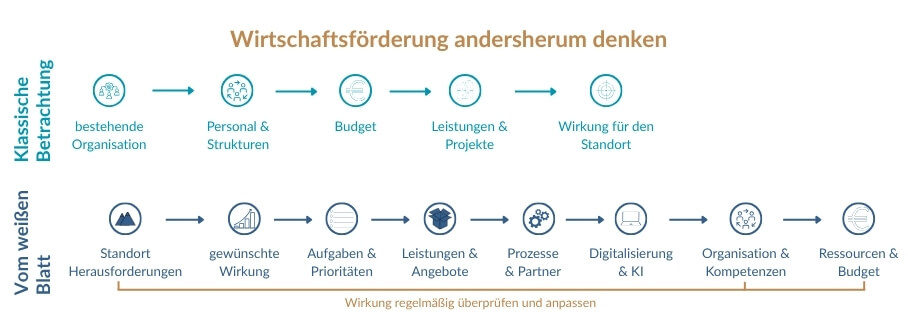
The Traditional Approach vs. a Blank Slate: What if we approached economic development from a different angle—starting with the desired outcome? © Frank Balkenhol
Two white leaves might be even more interesting
This thought experiment takes on a new dimension when it’s not just the economic development agency itself that’s given a blank slate. What happens if management and the team, on the one hand, and key stakeholders, on the other, first answer the same question independently of one another? Namely:
What impact should economic development efforts have on our region in the coming years?
This could reveal some interesting differences. Perhaps the economic development agency views the transformation of the business landscape as one of its most important future tasks, while its stakeholders primarily expect new businesses to set up shop. Perhaps a service is viewed internally as indispensable, yet is hardly a priority for the owners. Or, conversely, political stakeholders may expect results for which hardly any resources have been made available so far.
Such differences would not prove that one side is right and the other is wrong. Rather , they would mark the beginning of an important (possibly moderated) discussion. After all, economic development can only be effectively managed if it is as clear as possible what impact is actually expected from it. And anyone who expects results must also be willing to set priorities.
The economic development agency may initiate this discussion itself
The greatest opportunity presented by this thought experiment may lie in the proactive approach taken by economic development agencies: They can wait until the budgetary situation, politicians, top administrators, or shareholders raise questions about costs and effectiveness. Or they can take the initiative themselves and say, “We’re putting ourselves to the test.” Not because we think our work is wrong, but because we want to know whether we can achieve even more for our region in the future with the resources we have.”
And with that, the role changes. Economic development becomes a key contributor rather than remaining merely a subject of the consolidation discussion. And the perspective is changing for their stakeholders as well. The key question is no longer simply: “How much economic development support can we still afford in the future?” But rather:
What impact do we want to have on the economic development of our region—and what kind of economic development support do we need to achieve that?
This shift in perspective is important. After all, the outcome may not simply be “less.” In the best-case scenario, processes can be digitized, tasks consolidated, or services provided in collaboration with partners to conserve resources. Or it may make more sense to invest some of those resources in new initiatives.
Digitalization and AI Are Changing the Landscape
This thought experiment would have been interesting even a few years ago. Digitalization and artificial intelligence have added a new dimension to it. That’s because today, for virtually any service, we can ask a question that wasn’t possible in the past:
How would we organize this task if we were developing it for the first time today?
Does every piece of information have to be provided in person? Does every business require the same level of support? What early warning signs might indicate investment opportunities, difficulties, or the need for transformation? Which routine processes can be automated? Where does technology create the flexibility that in-person business development needs to handle complex cases?
AI does not replace economic development. But it changes the ways in which economic development agencies can use their limited resources. And that is exactly why it belongs on the blank page.
From a turning point to a turning point of opportunity: The new role of economic development
Crises, transformation, and geopolitics are fundamentally changing the rules of the game for business locations. Traditional economic development agencies are reaching the limits of what their tools can achieve. How must economic development agencies position themselves to remain capable of action, relevant, and effective? In this article, expert Frank Balkenhol offers potential solutions and provides background information.
First, the question of effectiveness; then, the question of money
Of course, money has to be discussed in the end. But perhaps it should be discussed at the end, not at the beginning. Only once it is clear what impact a location can expect, what services are necessary to achieve that, and how these can be organized effectively today, can we seriously ask:
- How much does this model cost?
- Where are opportunities for efficiency gains?
- Where does value get created?
- What resources can actually be saved?
- And which resources might be better allocated to new, future-oriented tasks?
The outcome of such a process, therefore, need not be “less economic development.” Rather, the goal would be an economic development agency whose mission, resources, and organization are aligned as closely as possible with the desired impact for its region.
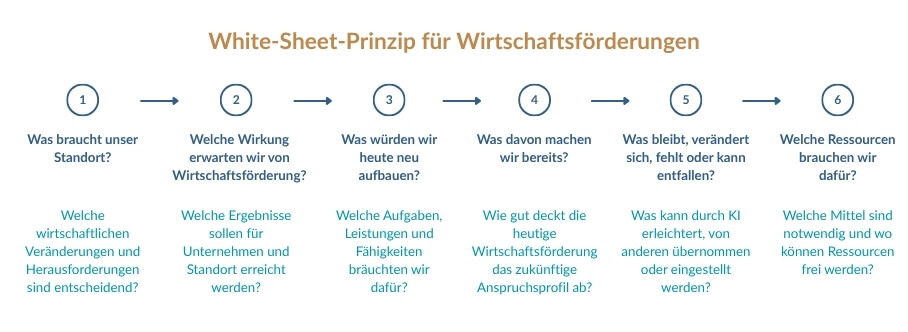
The White Sheet Principle: A thought process and working method for consistently aligning economic development with the desired outcome © Frank Balkenhol
Conclusion: Maybe now is exactly the right time
No one rebuilds an economic development agency from scratch every year. And, of course, established organizations cannot simply be wiped out and restarted. That’s not the point, anyway. The blank page is, first and foremost, a space for free thinking. It allows us, for a moment, to avoid making existing structures the starting point for every line of thought.
Especially in economically and financially challenging times, this could present an opportunity. After all, the alternative would be to wait until changes are demanded from outside before even considering them.
How about actually placing a blank sheet of paper in front of you right here and now?
Don’t write down what your economic development agency is doing today. Instead, start by writing down only the economic changes you want to achieve in your community over the next five years.
And if you’d like, you can share your thought experiment with me: frank.balkenhol@stadtmanufaktur.com. I’m looking forward to hearing from you.
Frank Balkenhol
ist Experte für Wirtschaftsförderung und Standortentwicklung bei der Stadtmanufaktur. Franks größte Leidenschaften: Städte, Standorte und Skifahren.